How collaborative editor works under the hood.
Ever wondered how google docs or any other collaborative editor manage to work consistently and smoothly when concurrent users are making changes at the exact same time? How can a system handle multiple writes to the same position concurrently without crashing or causing anyone to lose their work?
Conflict-free Replicated Data Type (CRDT) is a special kind of data structure that merge different states of work, resolve the conflicts and guarantee that every concurrent user eventually reach the same state without the need of manual conflict resolution.
Why do we even need CRDT?
CRDT is the core of today’s collaborative editors. But why you even need CRDT? Let’s say you(A) and you’re friend(B) are working on a same google doc.
A writes "hey" → went to server → saved in db
B writes "hi" → went to server → saved in db
Imagine a really common scenario where you both are writing at the same time
A is writing "hello"
B is writing "bye"
both the states reached the server and now there are conflicts
- which state to save in db?
- if saving both should A state comes first or B?
Similarly there are many scenarios, like A is writing and B is deleting at the same time or A and B both are deleting and many more. How do you solve this? You need something that solves these conflicts without any loss of work or inconsistent states for every user.
Here comes CRDT that resolves these conflicts for you and guarantee every user reach the same consistent state of work. There are 2 types of CRDT
- State-based CRDT (CvRDT): Complete local state of each user (replica) are shared between each other.
- Operation-based CRDT (CmRDT): Replica broadcast or share only the operations instead of complete state.
CRDT ensures 3 properties:
- commutative: a + b = b + a
- associative: a + (b + c) = (a + b) + c
- idempotency: no duplicates
Both have their own data structure and algorithm with various pros and cons. One of the operation-based CRDT’s is RGA, that you’re going to see in the next section.
RGA
Replicated Growable Array (RGA) is an operation-based CRDT for ordered sequences, such as text in collaborative editors. Instead of simply storing complete strings or arrays, RGA assigns every character a globally unique ID. When a new character is inserted it doesn’t store its position instead it stores the reference of the character after which it was inserted i.e. its parent.
Structure of the RGA Node
There’s always a special HEAD node in an RGA. It doesn’t store any character instead, it acts as the starting point of the document. The very first inserted character references the HEAD node as its parent.
A minimal RGA node contains the following properties.
Node {
  id: UUID,
  character: string,
  parent: UUID | null,
  tombstone: boolean
}- ID – It’s a globally unique identifier assigned to each node while insertion.
- character – The actual character stored in this node.
- parent – The ID of the character after which this node was inserted. The very first node points to a special
HEADnode (ornull, depending on the implementation). - tombstone – A boolean flag used to mark a node as deleted. Instead of physically removing a node, RGA simply marks it as
true. When rendering the final document, nodes marked astombstone = trueare skipped.
HEAD
  │
  ▼
H(id=1)
  │
  ▼
e(id=2)
  │
  ▼
y(id=3)
RGA make use of lamport clock, in simple terms it is a global clock that keep systems in sync.
Every RGA has some fundamental functions. I’ll walk you through each function try to make you understand how RGA works internally.
Lamport Clock
class IDGenerator {
    private counter = 0;

    constructor(private replica: string) { }

    next(): ID {
        return {
            replica: this.replica,
            seq: ++this.counter,
        };
    }

    update(remoteSeq: number) {
        this.counter = Math.max(this.counter, remoteSeq);
    }
}
localInsert()
Whenever a user types something, it is first stored locally using this function. This takes 2 arguments, the index at which you want to insert and the character you want to insert.
In the code you’ll notice, it internally calls remoteInsert(), I’ll come to that function also later in the section.
localInsert(index: number, character: string): Node {

    // it finds the parent node
    const parentNode = index > 0 ? this.findVisibleNode(index - 1) : this.head();

    const nextId = this.idGenerator.next(); // generates a new ID for the new node.
    return this.remoteInsert(nextId, character, parentNode.id);
}
remoteInsert()
This function basically handles the merging and conflict resolving task for the connected users/replicas and guarantee to generate a deterministic and constant state for each of them
It is the most important and most confusing function amongst all. But no need to worry I’ll show the complete flow of insertion and deletion with different cases soon in this blog.
remoteInsert(id: ID, character: string, parentID: ID) {
    // check idempotent
    const dupNode = this.findById(id);
    if (dupNode) return dupNode

    this.idGenerator.update(id.seq)

    // find place to insert, but before that create a node
    const node = new Node(id, character, parentID);
    const parentIdx = this.nodes.findIndex(n => n.id.replica === parentID.replica && n.id.seq === parentID.seq);
    if (parentIdx == -1) return node;

    const isChildOf = (a: ID | null, b: ID): boolean => !!a && a.replica === b.replica && a.seq === b.seq;

    let insertIdx = parentIdx + 1;
    while (insertIdx < this.nodes.length) {
        const neighbor = this.nodes[insertIdx];

        if (!neighbor) break;

        // Walk up from `neighbor` to whichever ancestor is a *direct*
        // child of parentID (a true sibling of the node being
        // inserted). Without this, a neighbor that is actually a
        // grandchild of a sibling would get compared as if it were a
        // sibling itself, which breaks a whole subtree out of order and
        // makes insertion order-dependent (not commutative).
        let sibling = neighbor;
        while (!isChildOf(sibling.parent, parentID)) {
            const next = sibling.parent ? this.findById(sibling.parent) : undefined;
            if (!next) break;
            sibling = next;
        }

        if (!isChildOf(sibling.parent, parentID)) {
            break; // left parentID's subtree entirely
        }

        if (this.compareIds(node.id, sibling.id)) {
            break; // new node wins, insert before this sibling's whole subtree
        }

        insertIdx++; // sibling wins, keep skipping past its subtree
    }

    this.nodes.splice(insertIdx, 0, node);
    return node;

}
localDelete()
localDelete(index: number): ID | null {
      const targetNode = this.findVisibleNode(index);
      if (targetNode.id.replica === "HEAD") return null; // nothing to delete
      targetNode.tombstone = true;
      return targetNode.id;
  }
remoteDelete()
remoteDelete(id: ID): void {
       const node = this.findById(id);
       if (node && !node.tombstone) node.tombstone = true;
   }
The basic architecture and application is, 2 user are connected via websockets A and B.
- A types -> localInsert() -> remoteInsert(A operation on A state)
- B types -> localInsert() -> remoteInsert(B operation on B state)
- A operation reaches B -> remoteInsert(A operation on B state)
- B operation reaches A -> remoteInsert(B operation on A state)
Now here you may change the order, but the end result would be exactly same ensuring the first 2 properties of any CRDT i.e. commutative and associative.
Using these functions let’s do a dry run on different cases.
Case 1: A inserts, then B inserts
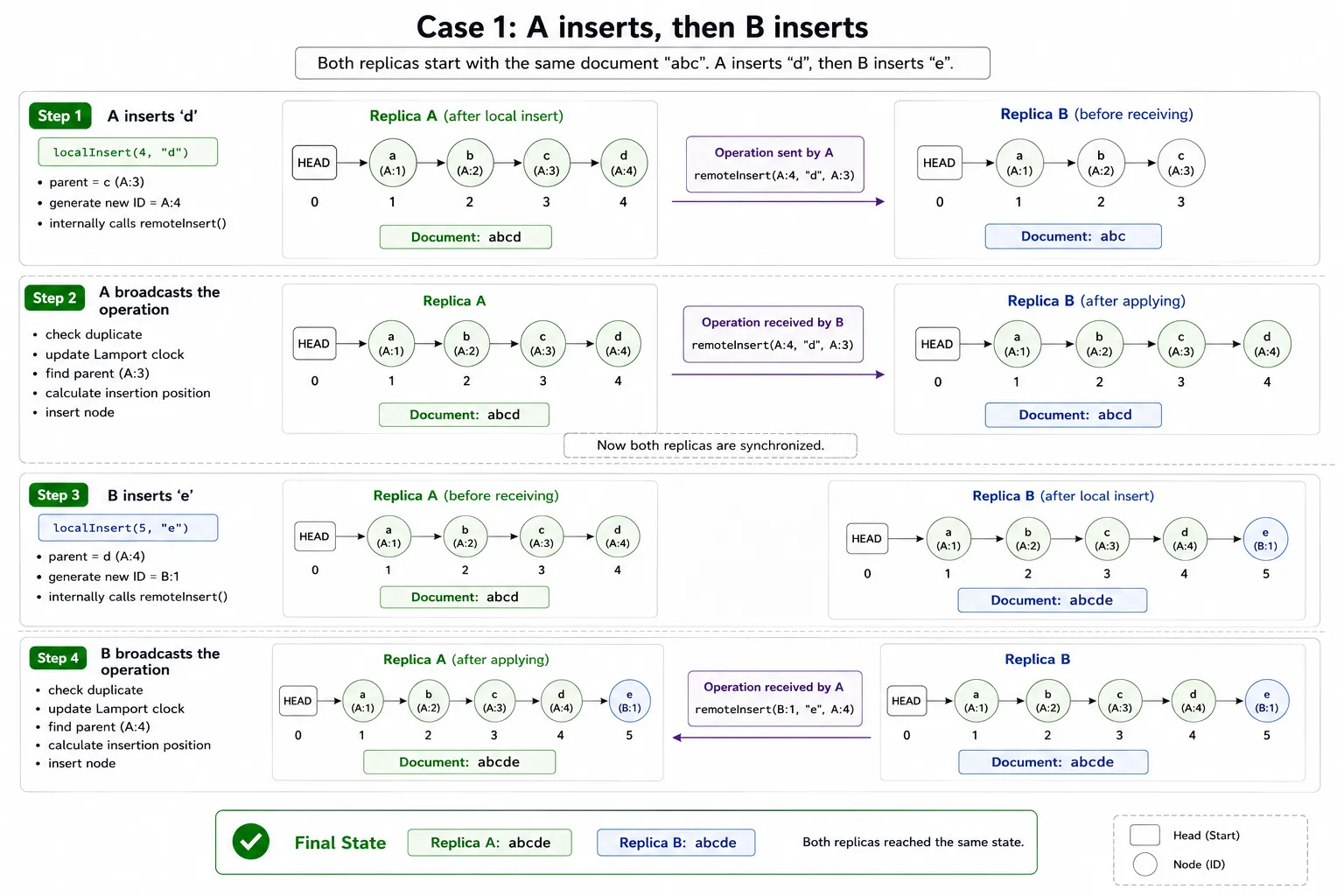
Let’s assume there are two users, A and B.
The original document is
abcSince user A initially created the document, the nodes are stored as
Idx     ID      Character
0       HEAD    ""
1       A_1     a
2       A_2     b
3       A_3     c
User A types first.
User A types → dUser A inserts d
localInsert(4, "d")// Finds parent = A_3 ("c")
// Generates ID = A_4
// Calls remoteInsert(A_4, "d", A_3)Inside remoteInsert()
parentIdx = 3
insertIdx = 4

insertIdx < nodes.length
4 < 4 = false
Since there are no nodes after the parent, the node is inserted immediately.
Current state of User A
Idx     ID      Character
0       HEAD    ""
1       A_1     a
2       A_2     b
3       A_3     c
4       A_4     d
Document
abcdUser A broadcasts the operation
The following operation is sent to every connected replica.
remoteInsert(A_4, "d", A_3)User B receives the operation.
Inside remoteInsert()
// Duplicate check

parentIdx = 3
insertIdx = 4

insertIdx < nodes.length
4 < 4 = false
The node is inserted.
Current state of User B
Idx     ID      Character
0       HEAD    ""
1       A_1     a
2       A_2     b
3       A_3     c
4       A_4     d
Document
abcdNow both replicas are synchronized.
User A → abcd
User B → abcd
User B now inserts e
After receiving A’s operation, User B types e.
localInsert(5, "e")// Finds parent = A_4 ("d")
// Generates ID = B_1
// Calls remoteInsert(B_1, "e", A_4)Inside remoteInsert()
parentIdx = 4
insertIdx = 5

insertIdx < nodes.length
5 < 5 = false
Since there are no nodes after the parent, the node is inserted immediately.
Current state of User B
Idx     ID      Character
0       HEAD    ""
1       A_1     a
2       A_2     b
3       A_3     c
4       A_4     d
5       B_1     e
Document
abcdeUser B broadcasts the operation
The following operation is sent to User A.
remoteInsert(B_1, "e", A_4)User A receives the operation.
Inside remoteInsert()
// Duplicate check

parentIdx = 4
insertIdx = 5

insertIdx < nodes.length
5 < 5 = false
The node is inserted.
Current state of User A
Idx     ID      Character
0       HEAD    ""
1       A_1     a
2       A_2     b
3       A_3     c
4       A_4     d
5       B_1     e
Document
abcdeFinal State
User A → abcde
User B → abcde
Since the operations happened one after another instead of concurrently, there were no conflicts to resolve. Every replica simply replayed the same operations in the same order, resulting in the same final state.
Case 2: Two users insert at the same position concurrently
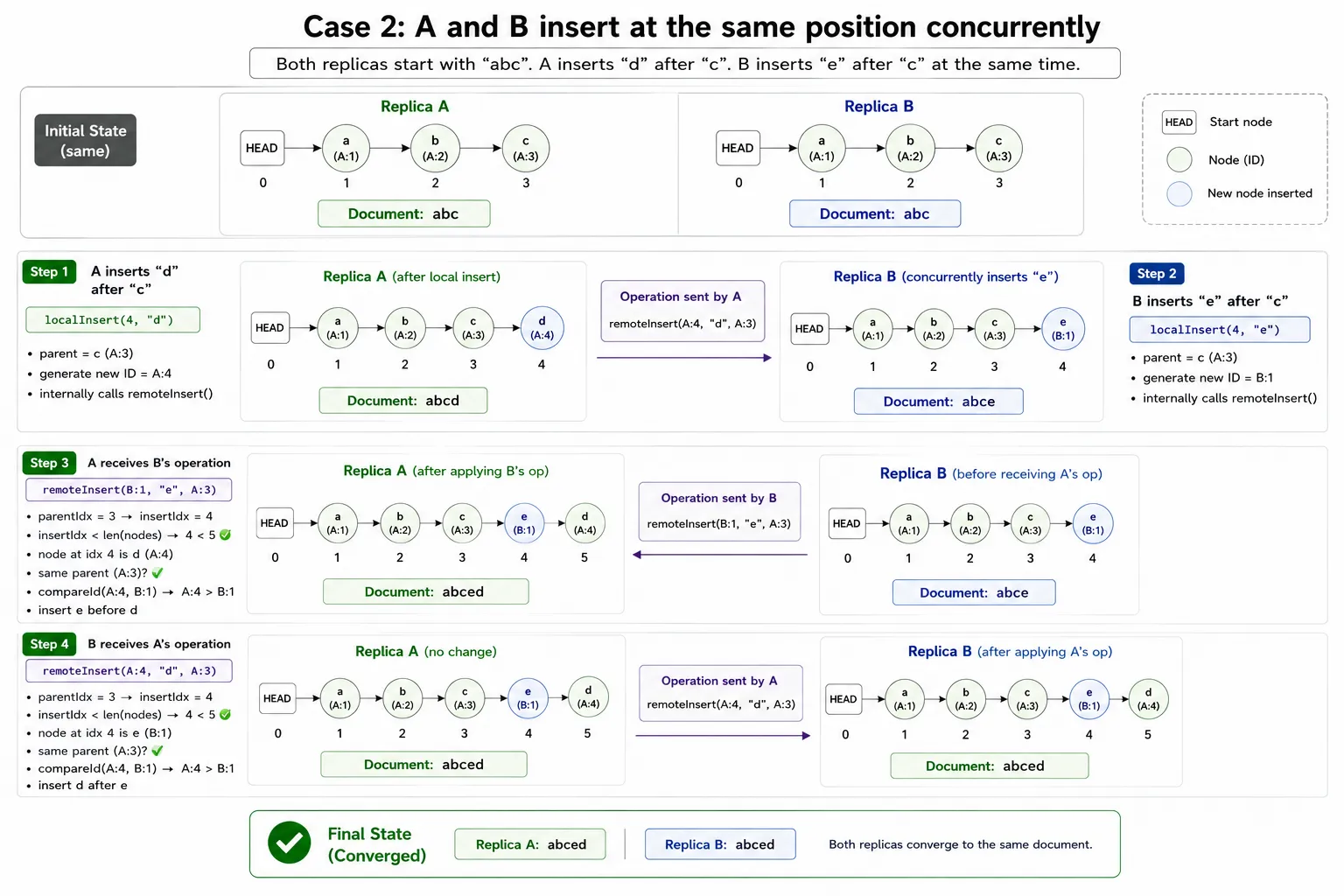
Let’s assume there are two users, A and B.
The original document is
abcSince user A initially created the document, the nodes are stored as
Idx     ID      Character
0       HEAD    ""
1       A_1     a
2       A_2     b
3       A_3     c
Now both users type at the exact same position.
User A types → d
User B types → e
User A inserts d
localInsert(4, "d")// Finds parent = A_3 ("c")
// Generates ID = A_4
// Calls remoteInsert(A_4, "d", A_3)Inside remoteInsert()
parentIdx = 3
insertIdx = 4

insertIdx < nodes.length
4 < 4 = false
Since there are no nodes after the parent, the node is simply inserted.
Current state of User A
Idx     ID      Character
0       HEAD    ""
1       A_1     a
2       A_2     b
3       A_3     c
4       A_4     d
Document
abcdUser B inserts e
At exactly the same time, User B performs
localInsert(4, "e")// Finds parent = A_3 ("c")
// Generates ID = B_1
// Calls remoteInsert(B_1, "e", A_3)Inside remoteInsert()
parentIdx = 3
insertIdx = 4

insertIdx < nodes.length
4 < 4 = false
Again, there are no nodes after the parent, so it is inserted immediately.
Current state of User B
Idx     ID      Character
0       HEAD    ""
1       A_1     a
2       A_2     b
3       A_3     c
4       B_1     e
Document
abceAt this point, both replicas have diverged.
User A → abcd
User B → abce
Operations are exchanged
The operations are now exchanged through WebSockets.
User A receives

remoteInsert(B_1, "e", A_3)

User B receives

remoteInsert(A_4, "d", A_3)
User A receives User B’s operation
Current document
abcdOperation
remoteInsert(B_1, "e", A_3)Inside remoteInsert()
// Duplicate check

parentIdx = 3
insertIdx = 4

insertIdx < nodes.length
4 < 5 = true
The current node at index 4 is
A_4 ("d")We first check whether it is a direct child of the parent (A_3).
A_4.parent == A_3

✓ Direct child
Now both nodes are siblings, so we compare their IDs.
compareId(A_4, B_1)Since
A_4.seq = 4
B_1.seq = 1

4 > 1
B_1 wins and should be inserted before A_4.
Final node order becomes
Idx     ID      Character
0       HEAD    ""
1       A_1     a
2       A_2     b
3       A_3     c
4       B_1     e
5       A_4     d
Document
abcedUser B receives User A’s operation
Current document
abceOperation
remoteInsert(A_4, "d", A_3)Inside remoteInsert()
// Duplicate check

parentIdx = 3
insertIdx = 4

insertIdx < nodes.length
4 < 5 = true
The current node at index 4 is
B_1 ("e")Again, both nodes are direct children of A_3.
compareId(A_4, B_1)A_4.seq = 4
B_1.seq = 1
4 > 1Since B_1 should come before A_4, A_4 is inserted after B_1.
Final node order becomes
Idx     ID      Character
0       HEAD    ""
1       A_1     a
2       A_2     b
3       A_3     c
4       B_1     e
5       A_4     d
Document
abcedFinal State
User A → abced
User B → abced
Even though both users inserted different characters at the exact same position and received the operations in different orders, both replicas converged to the same final state. This deterministic ordering is what makes RGA conflict-free.
Case 3: A deletes while B inserts concurrently
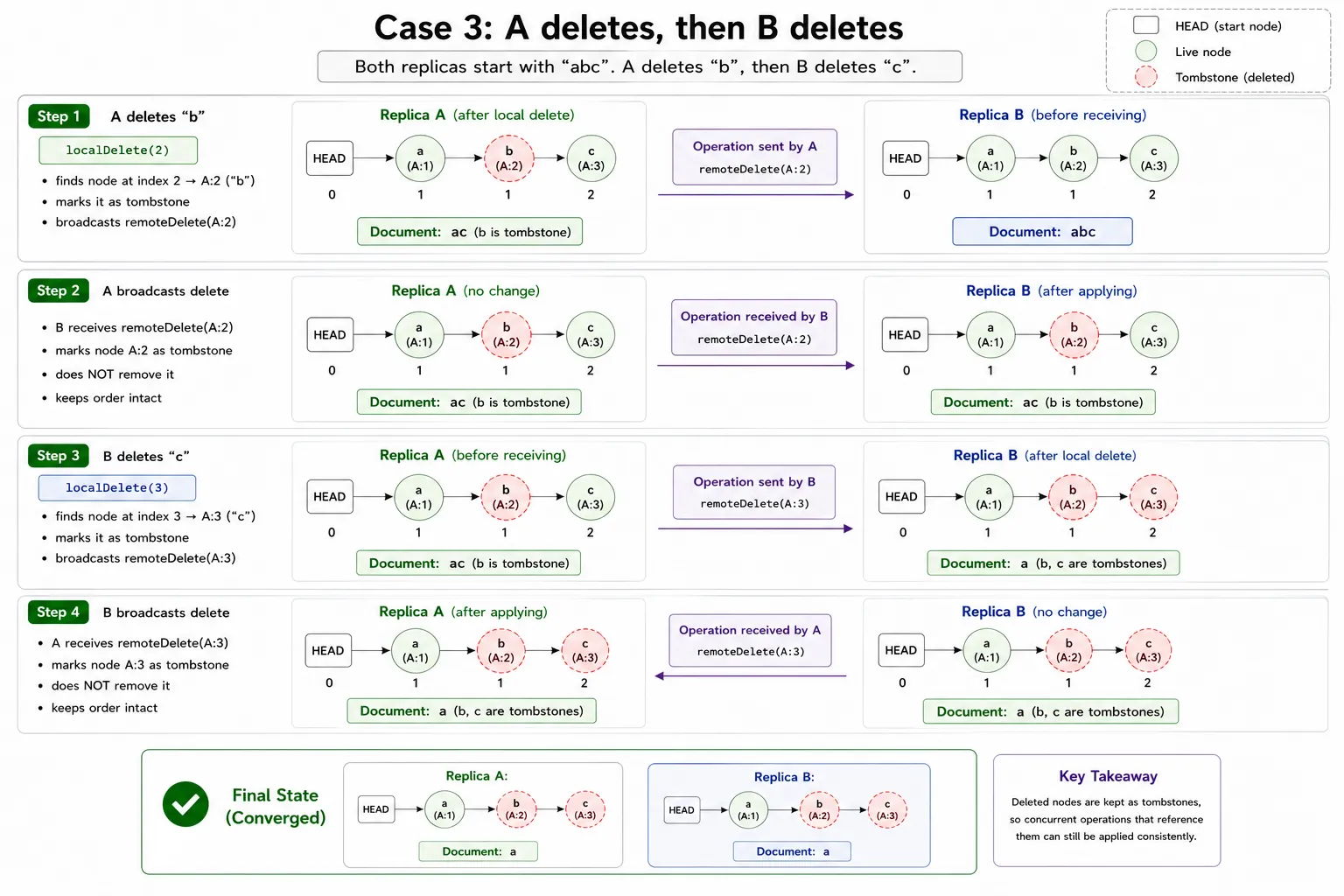
Let’s assume both replicas start with the same document.
Document = "abc"

HEAD
 │
 ▼
a(id=A:1) → b(id=A:2) → c(id=A:3)
Replica A
abcReplica B
abcNow both users make changes at the same time.
User A deletes → c
User B inserts → d after c
Step 1: A deletes c
A deletes the last character.
localDelete(3)// finds the visible node at index 3
// target = A:3 ("c")
// marks the node as a tombstoneInside localDelete():
targetNode = A:3

targetNode.tombstone = true
The node is not physically removed.
Replica A now looks like:
HEAD
 │
 ▼
a → b → c(tombstone)
Since tombstone nodes are skipped while rendering:
Document = "ab"Replica B is still:
a → b → c

Document = "abc"
A broadcasts the delete operation:
remoteDelete(A:3)But B hasn’t received it yet.
Step 2: B inserts d
At the same time, B inserts d after c.
localInsert(4, "d")// parent = A:3 ("c")
// generate new ID = B:1
// internally calls remoteInsert()B’s local state still contains c, because it hasn’t received A’s delete operation yet.
Inside remoteInsert():
parentIdx = 3
insertIdx = 4

insertIdx < nodes.length
4 < 4 = false
So d is inserted after c.
Replica B becomes:
HEAD
 │
 ▼
a → b → c → d
Document:
abcdAt this point:
Replica A = ab
Replica B = abcd
Step 3: A receives B’s insert operation
A now receives:
remoteInsert(B:1, "d", A:3)A’s current state is:
a → b → c(tombstone)Inside remoteInsert():
parentIdx = 3
insertIdx = 4

insertIdx < nodes.length
4 < 4 = false
Even though c is a tombstone, the node still exists in the internal structure.
Therefore, d can still reference c as its parent.
Replica A becomes:
HEAD
 │
 ▼
a → b → c(tombstone) → d
When rendering the document, the tombstone is skipped.
Document = "abd"Step 4: B receives A’s delete operation
B now receives:
remoteDelete(A:3)Inside remoteDelete():
const node = this.findById(A:3)

node.tombstone = true
The node is not removed.
Replica B becomes:
HEAD
 │
 ▼
a → b → c(tombstone) → d
When rendering:
Document = "abd"Final State
Replica A = abd
Replica B = abd
Both replicas eventually converge to the same state.
The important part here is that c was never physically removed.
a → b → c(tombstone) → dThe c node is still part of the internal RGA structure, which means d can continue to reference it even after c has been deleted.
This is one of the reasons RGA uses tombstones. A node can be logically deleted from the document while still remaining in the underlying data structure so that concurrent operations referencing that node can be handled correctly.
A deletes c
        ↓
c becomes tombstone
        ↓
B concurrently inserts d after c
        ↓
Both operations are exchanged
        ↓
c remains internally, but is not rendered
        ↓
Final document = "abd"
You can get the source code from here and try running the application locally to see it in action. In README.md you can get some more information on this.
Conclusion
CRDTs solve one of the hardest problems in collaborative editing, handling concurrent changes without losing data or creating inconsistent states. RGA does this by giving each operation a deterministic way to merge with others, allowing every replica to eventually reach the same state.